The Great Outdoors
In August of 2009, a good friend of mine had an art show at Club Soda. Downtown wasn’t yet revitalized to the extent it is today. Parkview Field had just opened.
On opening night, we stood sipping libations on the second-floor deck and looking out at the city in twilight. This stirred in us sensations that we hadn’t experienced in Fort Wayne before.
We felt urbane, cosmopolitan. We felt hopeful about Fort Wayne’s future.
Everybody who was there still talks about this as being one of the best nights of their lives.
As it turns out, we were right to feel hopeful about Fort Wayne’s future.
And we were right to be enjoying food and drink outside in August.
I learned recently that August 31 is national Eat Outside Day.
The origins of this holiday are unknown to me.
Is there an Eating Outside Marketing Board? Is it run by pigeons and seagulls?
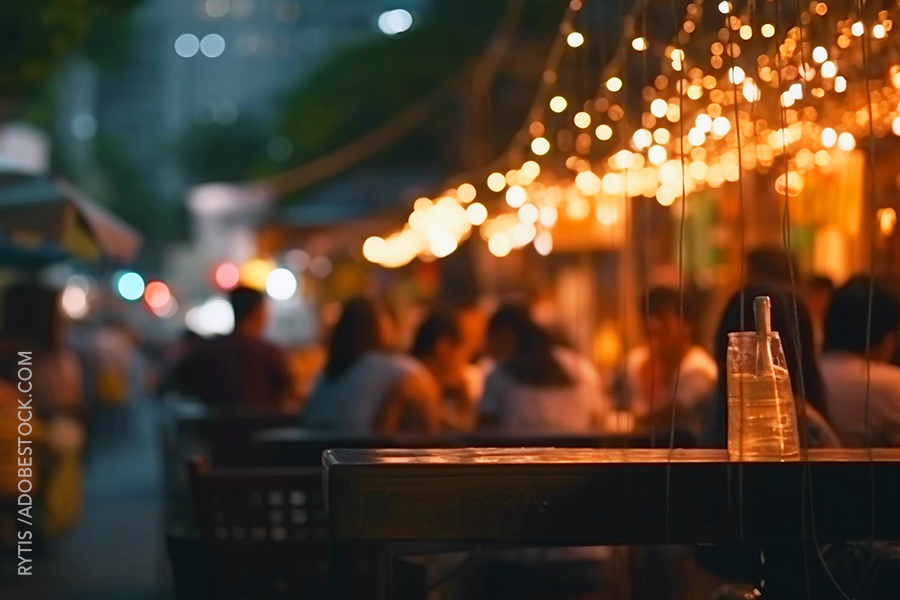
But August 2023 does seem like a perfect month to do a lot of eating and drinking outside, either on a restaurant patio or on a blanket in one of our fine parks.
Club Soda had one of the few patios of note in 2009, but now there are plenty.
This is shaping up to be one of the hottest summers on record. There may come a year when it is generally too hot to eat and drink outside.
There may come a day when sitting on a restaurant patio is a form of punishment, reserved for habitual low-tippers and the people who are known for ordering well-done steaks and putting ketchup on them.
Rather than speculate about the future of outdoor dining and drinking, I decided to look into the history of outdoor dining and drinking.
I MAY EAT THESE WORDS
Common sense tells me that early man had to eat outdoors because there weren’t a lot of areas that would have qualified as indoors.
Later, eating and drinking outside was seen as vulgar in some cultures.
In an article at Medium.com, a modern writer named Hanzhang Yang quotes an older writer named Di Mo and his assessment of an ancient king named Qi of Xia.
“Xia Qi indulges in debauchery, eating and drinking ferociously in the wild” is Yang’s translation.
If you are going to indulge in debauchery, you may as well do it ferociously, it seems to me.
In medieval times, outdoor feasts were held for hunting parties before they went out on excursions, according to a post on the Comoncy Cafe website. One of the stumbling blocks, literally and figuratively, to full enjoyment of outdoor eating back then must have been the size of the food.
It is hard to seem debonair when you are having trouble lifting a venison haunch.
The man who ultimately made eating outdoors acceptable (and portable) may have been Charles Feltman, according to a post on The Culture Trip website.
Feltman, a German immigrant, operated a pushcart at Coney Island in the late 19th century. He started selling pork sausages on rolls and inadvertently invented what would soon come to be known as the hot dog.
Whatever else you may want to say about them (and their alleged contents), hot dogs were walking-around food and may have helped dispel any lingering reservations about the appropriateness of dining al fresco.
Incidentally, did you know that al fresco (“in the cold air” in Italian) has become a slang term in Italy for being in prison?
Bottom line, if an Italian person asks you if you’d like to eat al fresco, don’t immediately say yes.
You might find yourself in a jail cell eating nutraloaf.
So, that’s the (extremely-incomplete-and-likely-incorrect) story of eating outdoors (which was not intended to be read by anyone confined to an Italian prison). What about the story of drinking outdoors? Well …
DRINKS ON (OR OUTSIDE OF) THE HOUSE
“Cocktails, in general, were inspired by British punches, which contained spirits, fruit juice, and spices in large bowls,” according to a post on the website for New York’s Ward III.
The next time I see a young woman at a casual-dining restaurant drink a margarita out of a glass the size of a punch bowl, I will know that cocktails have come full circle.
Jeremiah “Jerry” P. Thomas, a New York City bartender, wrote the first drinks book published in the United States in 1862.
Thomas’ signature cocktail was the blue blazer, which was a “flaming whiskey toddy poured between cups in a pyrotechnic arc,” according to Saveur magazine.
In his movie “Cocktail,” Tom Cruise paid tribute to Thomas by mixing a drink that involved an arc of flaming thetans.
Due to the social conventions of Thomas’ period, women were “expected to prepare the (cocktails) for their husbands but not partake in them themselves,” according to an article at Tastingtable.com. It was, therefore, scandalous when actress Lillie Langtry threw a coed drinking party in 1903.
According to an article on Atlas Obscura, a moral scold described attendees of Langtry’s party as “jeweled gin suckers.” In doing so, he inadvertently made them sound even cooler than they were, something moral scolds haven’t been able to stop themselves from doing ever since.
It was Missourian Clara D.D. Bell Walsh who officially started the cocktail party craze in St. Louis in 1917.
Her hour-long party, at which attendees were encouraged to stand and mingle rather than sit, became a national news story.
Walsh also created something called a “baby party,” during which “adults were encouraged to drink booze from baby bottles,” according to a post on the Dusty Old Thing website.
We should be grateful to the newspapermen of the time for not turning the baby party into a national craze.
Prohibition killed the cocktail craze, but tiki culture helped resuscitate it.
Ernest Raymond Beaumont Gantt opened the first Polynesian-themed bar and restaurant, Don’s Beachcomber, in Hollywood in 1933, according to a post on the Cocktail King website. Inspired by Beaumont-Gantt, Vic Bergeron opened his first Trader Vic’s in 1960.
Beaumont Gantt eventually had his name legally changed to Donn Beach.
He wasn’t the last entrepreneur to go to these lengths. If you don’t believe me, look for the Wikipedia entry on Hank Goditsfriday.
The quality of tiki drinks degraded over time, but they were initially quite bold and distinctive.
“Once subtle cocktails grew increasingly syrupy and indistinguishable, leaving us with the sickly-sweet beverages that many associate with the movement today,” according to a Smithsonian magazine article.
For many of his rum-based drinks, Beaumont Gantt followed a Jamaican rhyme: “One of sour, two of sweet, three of strong and four of weak.”
This was later used as the tagline for the “Expendables” films.
Tiki culture has gotten a lot of well-earned flak for cultural appropriation, but it’s not hard to see why American adults of the 1950s and 1960s embraced this trend.
Walk through a landscape dominated by brutalist architecture and polyester and you too will be seduced by a doorman saying, “Want to sit on some bamboo furniture while drinking a Mai Tai?”
Cocktail culture took another hit when recreational drug use became popular among young people in the 1960s.
Both seem to be coexisting more seamlessly today, for some reason.
WHERE EVERYBODY KNOWS YOUR NAME
Tiki culture is alive and well in northeast Indiana.
There are tiki bars at the Channel Marker (5793 E. Pickwick Drive, Syracuse) and Howie’s on Hamilton (3950 E. Bellefontaine Rd, Hamilton).
Spike’s Beach Grill (310 Eastlake Drive, Warsaw) is designed to evoke the ambience of a seaside hangout.
And in downtown Fort Wayne, we have the Sidecar (301 W. Jefferson Boulevard, Suite 99), with its plastic palm trees and whimsical glasses.
The Deck at the Gas House (305 E. Superior Street) is one of the more popular places in Fort Wayne to eat and drink next to water.
A famous wrestler was once thrown out of the Deck. I don’t trust myself to name him. I might get it wrong because I’ve been feeling a little woooooooooozy today.
The Hall’s family must also be commended for managing to turn part of the Gashouse parking lot into a comfortable and attractive lounging and drinking area.
Of course, if I start naming my favorite patios, I will run the risk of forgetting a good one. But it’s a risk I must take.
Ever have a drink on the deck overlooking the Saint Mary’s at Curly’s Village Inn (4205 Bluffton Road)? If not, you really need to do it.
Charlie’s Place (4201 N. Wells Street), Three Rivers Distilling Company (224 E. Wallace Street), Welch’s Ale House (1915 Calhoun Street), Nawa (126 W. Columbia Street), Marquee on the Landing (123 West Columbia Street) and Coyote Creek Bar and Grill (4935 Hillegas Road) all provide distinctive patio-sitting experiences.
And how could I forget our rooftop bars and restaurants: Birdie’s (204 W. Main Street, 5th Floor) and Connor’s (223 W. Jefferson Boulevard, Suite 750). I didn’t forget, actually. I just wrote that for effect.
I have not yet visited Steady Eddy’s Station (14436 Leo Road, Leo-Cedarville), but I hear you can canoe or kayak up to it on the Cedarville Reservoir.
Make the most of these outdoor spaces in August. It won’t be long before you look down and see snow accumulating on your Mai Tai.