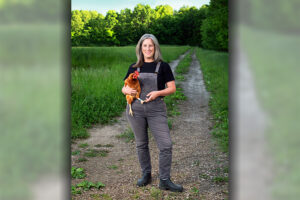
Table Talk – Zainab Gidado

Zainab Gidado left her native Nigeria two years ago to study abroad – and she choose Fort Wayne. Passionate about human rights and social justice, she found a temporary home in our city and specifically at Purdue University Fort Wayne, where her research is focused human rights and genocide recognition and prevention. During her brief time teaching and studying here, she’s made an impact. She has presented original research at conferences, she has been recognized with awards, including Outstanding Graduate Student and Teaching Assistant, and she served as president of the African Student Association. I talked with her about her work, how she has built community and her strategies for building a home-away-from-home.
How would your closest friends describe you? My friends would say I’m the calm one who really listens even when things are chaotic. They would also say that while I enjoy a good laugh, I am fully committed to learning and advocating for important causes.
Why Fort Wayne? I chose PFW because of the diverse research of the faculty and their commitment to mentorship. It felt like the kind of place where my work and voice would matter.
What do you wish you knew when you first moved to Fort Wayne? I wish I knew it was okay not to have everything figured out right away. Moving to Fort Wayne was exciting but also came with a lot of self-doubt and imposter syndrome. Journaling in Professor Michelle Kelsey’s classes and speaking with Professor Kevin Stoller helped me realize I wasn’t alone and that made a huge difference. Looking back, I now see that my unique perspective and experiences with all the complexities of my background were actually my biggest strengths.
How has the African Student Association helped you make connections in FW? It became my family the moment I landed. One member picked me up from the airport and another graciously hosted me for my first few weeks. It gave me a real sense of home. And later, as president, I got to pay it forward by helping new students. ASO showed me that community isn’t just about where you’re from; it’s about showing up for others.
What motivates you in your work? I hope my work brings attention to genocidal atrocities that often get overlooked, especially in Africa. But more than that, I want people to see the power of communication in healing, advocacy and change. If my work helps even one person feel heard or understood, then I’ve done something right. I had the opportunity to do research in Burundi and met with a survivor of the 1972 massacre who told me, “This is the first time anyone has listened to me.” That hit me deeply and reminded me that my work isn’t just academic. It is personal and deeply human.
What’s one thing about the world that has improved in your lifetime? How people talk about mental health and trauma. There’s way more openness now, and folks are starting to realize that healing takes community, not just silence. It gives me hope to see more people sharing their stories and supporting each other without judgment.
Who or what inspires you? I’m inspired by people who turn pain into purpose, like survivors who speak up so history doesn’t repeat itself. I really admire people who use their voice to stand up for others instead of staying in their bubble. And my mom. She’s the definition of resilience and grace.
What does home mean to you? Home is a feeling. It’s where I feel safe to be myself, surrounded by people who see me, support me and make space for my voice. Whether it’s my family back home or the community I’ve built here, home is wherever I’m loved and understood.
What do you eat when you are homesick? When I’m homesick, I go straight for either jollof rice with fried plantains or semovita with ogbono soup, both classic Nigerian dishes. It’s the taste of home, comfort and childhood all in one bite.