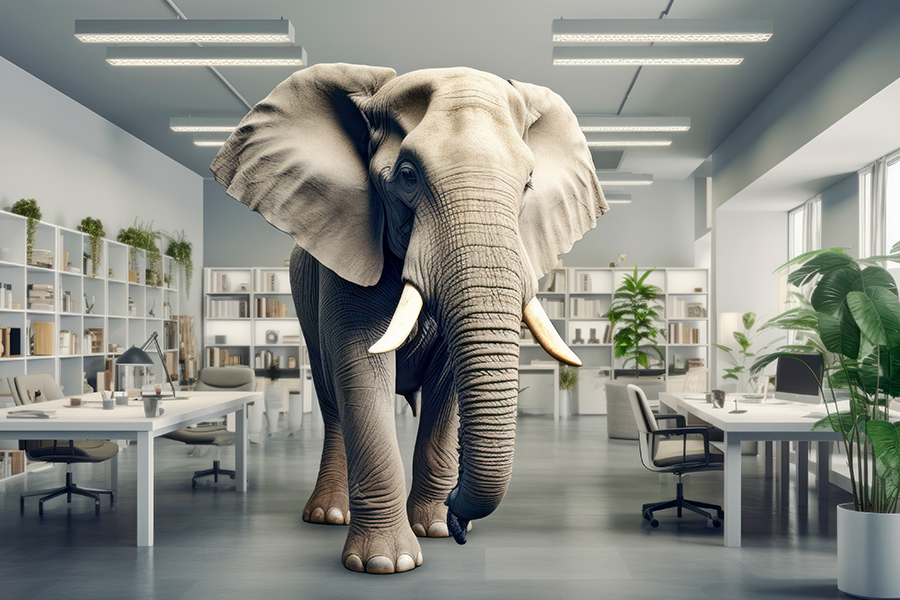
Elephant In The Room
People who are humorous can seem light to us (as in, both luminous and airy).
But many people employ lightness as a way of carrying heavy things as gracefully as possible.
Some possess an innate buoyancy of spirit. Others forge their humorous outlook in a furnace of adversity.
(Incidentally, Furnace of Adversity is my favorite Death Metal band. This observation is not especially relevant, but have you considered the possibility that some people work through their problems by making jokes at inappropriate times?).
Humor is a gift for some and a survival skill (which, I guess, is a gift wrested from the selfish clutches of the cruel cosmos) for others.
Take Kristen Kinnaley, for example. Kinnaley makes pots with hilarious sentences and sentence fragments on the side of them that may be some of the hottest commodities in the local art world. But she had this to say about her sense of humor: “You know, if you bury enough of your friends, you have to start making jokes eventually,” Kinnaley said. “Otherwise, you’d never get out of bed.”
For this humor-themed issue, I sought out visual artists whose sense of humor (as evinced in their work) I have always admired. Not surprisingly, I discovered that their use of humor serves purposes beyond simply making their work more marketable.
Adrian Guenther, whose work has featured characters from “The Smurfs,” “Land of the Lost” and “Leave it To Beaver,” said “humor takes the awkwardness out of things,” but no matter how humorous his work seems, “there is always darkness there.”
“It just cannot not be there,” he said. “I don’t know why.”
A painting about a missing elephant (who can be found on the back or “b-side” of the painting) is not just about a misplaced pachyderm. “What this painting is,” Guenther said, “is me struggling to quit drinking.”
Guenther’s use of B-sides, a nod to the days when 45 rpm records paired a hit with a deep cut, is another expression of his playful nature. “I want to surprise somebody,” he said. “You know, it’s like a secret.”
While Guenther uses humor to navigate and explore internal conflicts, Birdy Gosser uses it, at times, to diffuse external ones. Gosser, whose droll drawings are amusing, insightful and frequently both at the same time, said she has a habit of introducing humor when real-life situations become strained.
It’s easy for humans to take life a little too seriously, Gosser said. “I know I can be guilty of that myself,” she said.
Of course, sometimes life grows so serious that it becomes humor-proof, at least temporarily. Last year, Kinnaley’s father-in-law died after a long battle with Lewy Body Dementia and she ultimately decided to cut back on producing her popular pots for the time being.
“I felt a little bit painted into a corner when I got to this year,” she said. “I was like, ‘The way I need to process this grief now is actually going to involve slowing down and not just word vomiting whatever thought I have onto the side of a pot.'”
An artist who has achieved her level of success doing a particular thing has reason to feel both grateful and apprehensive. Kinnaley said she will never forget some advice she received from a college professor. “It was another rough time that I was going through, and I remember him telling me, ‘Look, you gotta kill your babies. You’ve already figured out that this one works. You know you can return to this if you need to. But does growth lie here?’
“So, I always have that kicking around in the back of my head,” Kinnaley said. “But to try and balance that with capitalism and having bills to pay … you know, I gotta feed my family.”
Kinnaley worries that her fans may be less enthusiastic about following her into new artistic territory, but I suspect that they are more interested in the artist than the destination.
For Guenther, commercial concerns are important, but the value of art ultimately cannot be measured in dollars. “Money is an outcome that is very gratifying, and all that,” Guenther said. “(But art) is already paying me daily in relationships and connections with other human beings. Because when you make art, you expose your soul for full viewing.”
One of the most important connections Guenther made was with his biological father, whom he did not come to know until after he’d turned 50. Together, they wrote and illustrated a beautiful and powerful children’s book called “The Man with Invisible Feathers.”
“He wrote some words, but I painted a different story, a deeper story,” Guenther said. “He had me do that, so he’s been a big part of my artistic journey as well.”
Find Guenther at facebook.com/adrian.guenther.39, Gosser at instagram.com/dirty.birdy and Kinnaley at kwatrousceramics.com.
Subscribe to Fort Wayne magazine for only $1 a month!
Order online at subscribe.fortwayne.com or call (260) 461-8519.